
The Planet Has Your Back
where a spontaneous psychedelic experience, ecopsychology and psychosynthesis meet on the Cornish cliffs....

The Planet Has Your Back
Considering “Set and Settingi”, usually with a wise other, often a guide or therapist, is an essential element for those preparing for a well-held journey into psychedelic therapy. “Set” is about one’s intention and purpose for the experience; “Setting” refers to elements of place and space, such as music, location, flowers, in which the experience is to occur. Such conscious preparation provides a solid foundation from which one may direct personal will in order to open to so-called “non-ordinary consciousness”.
Our normal waking consciousness, rational consciousness as we call it, is but one special type of consciousness, whilst all about it, parted from it by the filmiest of screens, there lie potential forms of consciousness entirely different. (William Jamesii).
But will is more than personal, and, as the song goes:
“once in awhile you get shown the light
in the strangest of places if you look at it right”
(Sugar Magnolia; Garcia/Hunter).
-----
This place is all about navigating edges and endings.
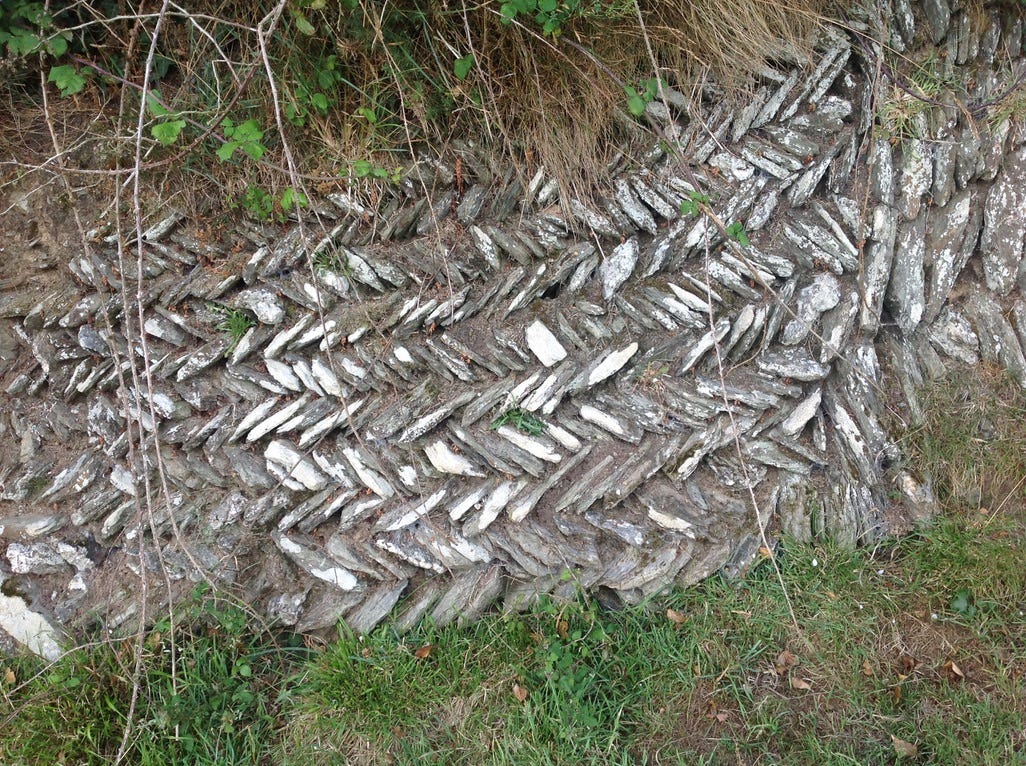
Photo: The ancient “herring-bone” style of building a wall, said to have been brought to Cornwall by the Romans.
The lane, overhung with oak trees, winds up from the edge of the old village. Stone walls, unchanged since Roman times, describe field edges, the ancient margins between one livelihood and another’s.
Not far to the west lies Lands End, and, just here, the rocky, scrubby point called Dodman – Dead-man – with its lonely, bare cross. Most crosses in Cornwall are of the Celtic style, cruciform overlaid with a circle, said to symbolise the marriage of Christianity with an older Wiccan spirituality. Inland, where the remains of tin mines profess to pre-Christian trading with the Mediterranean, there are legends of a merchant, Joseph, visiting from Arimathea in Judea, with his young nephew Jesus. The pair are said to have then headed up country to Glastonbury to study lore.
Our family came for my earliest holidays, where my parents retired, and where, eventually, I would bring my mother’s ashes and loose them to the four winds on her beloved cliffs: edges, endings – and mysteries.
The old lane reaches the Gruder, an open, windswept plateau, commanded by an isolated, sprawling country house that seems designed for a British murder story. Just beyond the muddy, foot-carved course of the Coastal Path that zigs the zagging coastline for 600 miles, the cliffs fall steeply to the English Channel.
And, it was the place where I had returned, apparently to sort things out at home, and help my mother prepare another bedroom for my ailing father. His illness had become a burden. Her friend had alerted me to my mother’s overwhelm in the face of what was probably their mutual avoiding of the obvious. Somewhere between my boarding the plane in Auckland and arriving at Heathrow, he had taken a turn for the worse and been whisked off to the hospital wing of a local rest home.
Soon after arriving here again, I had started a walking habit. Each morning: to the Gruder, past the mysterious house, and around the sea-pink and heather flowered cliffs on the coastal path back to the village. Witnessed by puffins, gulls, fulmars and seals, this had become a 50 minute communion with all that a son engages as he comes to the awareness of his father’s dying, and an only child acknowledges his mother’s ageing.
I’d spent most of the previous three decades living in Aotearoa/New Zealand, as far from the UK as one can get, unless one is an Adelie penguin. No-one ends up so far from their roots without good reason, and yet the bonds of all that is unresolved remain strong, even at such remove – or perhaps because of it.
I had recognised the damage my father had inflicted upon myself, my mother, himself and on others. I had initiated a new chapter in my own life, including therapy and subsequent retraining as a psychosynthesis guide and later teacher. For the decade since I had addressed the issues with him, his disavowal remained, a brittle half-acknowledgement, half-justification that didn’t seem my fight anymore.
Before retraining, I had worked in communication and fundraising, latterly for wildlife conservation. My decision had been prompted in part by the realisation that wildlife wasn’t the problem, it was human behaviour, worldviews and values, and fencing off a few hundred acres – or even tens of thousands of square miles – did nothing but perhaps slow the decline. The Rio Conference had been 12 years earlier, and since then the scenarios described by my scientist colleagues at the time had been as steady in their unfolding as my concern and growing unease.
-----
Until writing this piece, I had not so clearly seen some parallels at play. On the one hand being called home to help my overwhelmed mother against what had become thoughtless expectation and cruel demands on her generosity and goodwill from my father and his denial. On the other, being aware of a desire – a need – to somehow engage and align in the necessary restoration of right relations with our planetary home, Mother Earth, in the face of rapacious exploitation, avoidance, and disavowal.
To recognise a common pattern occurring at different levels of complexity is to recognise the fractal nature of existence and our meaning-making of it. For systems thinker Nora Bateson such processes point to transcontextuality, “the ways in which multiple contexts come together to form complex systems. It allows for a concentration on the interdependency between contexts that give resilience to both living and non-living systems.”
Nora Bateson coins new words. “Symmathesy” describes how “mutual learning” contexts are generated “through the process of interaction between multiple variables in a living entity.”
Unrecognised by me at the time, my existential reflections on my family situation chimed with those I was formulating in regard the existential challenge facing our world. We might see this as a significant factor – or set – informing my life at that time. Being in Cornwall and with time to engage deeply, my context – or setting – was shaped by a rich range of interacting contexts, historic, cultural, ecological, familial, spiritual and more.
-----
But, back then, I knew nothing about “set and setting”.

Photo: A view looking back along the Gruder towards the mysterious house. The coastal path weaves on the left of this picture. The village is around the headland.
it is a serious thing
just to be alive
on this fresh morning
in the broken world
Mary Oliver (2008)
It is already a stunning Autumn day, truly “a temple of golden dawn”. Edges, endings and mysteries: lets go walking.
The various daily tasks have settled together, a singular rhythm of deepening relationship with place, mother, father, absence, longing, belonging, healing, seasons, dying and more.
A maverick, restless energy informs my familiar walk up toward the headland. The season’s green, gold and brown shades sit well with the greys and silver-white mottle of lichened rocks. Its fresh, and brightening clear, and my self is soon drawn from a mental pre-occupation into a lively occupying participative space, shared sensually with stone, heather, birds and breeze.
Past the strangely empty house, across the skin-worn, wooden stile, and onto the track along the cliffs, almost skipping, it dawns on me that this moment, these sensations, the brambles, the stile, all the hands that have touched it, and this ‘me-ness’ – including ‘my’ issue – are intimately related. Something loosens up inside me and I pause for a moment. I just want to lay back on the heather.
Lying here, looking up into the vast, puffin swooping blue, I merge in and am profoundly received. A private wonder arises, a flowing – not so much between me and something else, or even between an inside and outside, but rather a current within a much wider wholeness that involves all elements and contexts.
It’s the strangest thing: one moment, here I am, lying back, gently held in the soft heather, clouds above, waves washing on the rocks below, feeling deeply held, steady, centred within this time of profound change.
Then, with no preamble or warning, everything shifts. Suddenly, I find myself no longer looking up into the sky. Instead, I feel physically suspended, looking down and down into a deep, luminescent night-space, a beyond further and deeper than anything I had ever experienced, with a quality of blue that I recognised again, years later, whilst keeping vigil beside my dying mother, and waking at the moment of her passing.
I am glued to the Earth, drawn back against this solid presence, palpable, hard against my spine. I feel the rising edge of vertigo, a touch of fear too. I am exposed and vulnerable. I am part of this. Built in. And it is huge. I am tiny.
I barely find meaning. There are choices, and consequences, and the planet is indifferent, huge, and I am tiny. But I can choose to remain aware, which I do, trusting the rock-solidness of this moment, and that changes everything.
There’s no word that describes an aural felt-sense filling the universe like calm, blue sonic treacle, as far as I know, but that is what happens now, chiming “The planet has your back”.
Complete relax and out-wide wonderfilling, ancient cliff is bone of bone, my senses are the ground, a tiny point of distinct-not-separate awareness within the biggest context never owned.
How long? Here, there and when…
And, in due course, the walking homeward … the steep path down from the stile to the roadway in the village, pausing in the iconic bakery where Barbara is ever-welcoming, and Ralph waves from the back through a miasma a flour dust…
-----
Aldous Huxleyiii described his mescaline experience as "a gratuitous grace," not necessary to salvation but potentially helpful... shaken out of the ruts of ordinary perception … directly and unconditionally, by Mind at Large—this is an experience of inestimable value...”.
That “gratuitous grace” has enabled me to risk and stretch and dare myself to step up, even when I have felt unsure alone or vulnerable. To know, viscerally, that the planet and my back are part of one intelligence has meant encountering the limits of my knowledge, capacity or courage. It helps me check my motives, intention and alignment, and, most of all, to build trust in a greater-than-human process.
In the participative spirit of Mind-at-large I have felt encouraged, guided, comforted and corrected in a process that has taken me deeply into ecopsychology, social ecology, community engagement and psychologically-informed activism (see Skelding, 2020).
In that participative spirit I am purpose-full.
-----
Making Sense of the Experience
Will Parfittiv does not shy from the esoteric foundations of Psychosynthesis, respectfully opening the so-called “wall of silence” to sound the space beyond, much as a sailor “sounds” the depth of unfamiliar waters. He is especially attentive to magick: "the science and art of causing change to occur in conformity with the will" (quoting Crowleyv). The magician’s art, says Parfitt (p187), “is in learning how to develop your own self-actualisation… To attain this you have to align yourself with the flow of natural energies and harmonise your existence with the natural world. This leads to a co-operative use of power…”.
For Assagiolivi: “...it involves a drastic transmutation of the normal elements of the personality, an awakening of personalities hitherto dormant, a raising of consciousness to new realms, and a functioning along a new inner dimension.”
These ingredients are likely familiar to many of us who have taken psilocybin, ayahuasca, LSD, mescaline or the like. Whether ostensibly for fun or for therapy, voluntarily ingesting a substance is an act of “personal will” – or, more correctly, Will expressing at the level of the individual. Differentiating Will into various levels – personal, transpersonal, Universal etc – is a little like distinctions between straits, gulf, and bay: useful as a way of giving context to the sailor, and its all the same ocean.
Nora Bateson writesvii: “Contexts are mixing as they are informing, transferring, melting together cognition. Go with multiple description into the landscape in which none of the maps apply…. Your health is a measurement not of your vitals but of your ability to perceive and give vitality to the overlapping living processes around you, beyond you, within you. The transcontextual work is there, waiting”.
Talking to Sam Keenviii, Assagioli stressed the importance of understanding and engaging with the levels of context, each an expression of will. “Like it or not, everyone is a part of the universal will and must somehow tune in and willingly participate in the rhythms of universal life.” His comment points to direct relationships between our sensing selves, universal will, and the rhythms of universal life expressing in every moment. Whilst personal will is the driving force in incidents of formal “psychedelic therapy”, access to “non-ordinary consciousness” can arise from any of the three elements mentioned: the part (ourselves), the rhythms in the moment (context/setting) and the overall process of the whole (universal will – set).
I suspect that such moments are very available. Changes to the rhythms of our lives caused by significant events – moon landing, 9/11, natural world encounters, and most often the death and birth of loved ones – can lead to the parting of James’ “flimsy screens” as familiar rhythms are interrupted. Such interruptions, when not integrated, can lead to trauma. Psychedelic trauma therapy may be so effective because it contextualises ordinary consciousness, and its interruption, within a bigger frame, enabling integration and learning.
-----
But what of the Universal? Might there be a call from whole to the part?
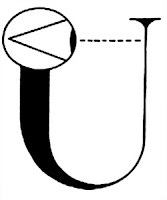
Physicist John Wheeler’s image for a participatory “self observing universe” which he describedix as “Beginning with the big bang, the universe expands and cools. After eons of dynamic development it gives rise to observership. Acts of observer-participancy — via the mechanism of the delayed-choice experiment — in turn give tangible "reality" to the universe not only now but back to the beginning. To speak of the universe as a self-excited circuit is to imply once more a participatory universe.” (And, to speak of it as a circuit suggests that the Big Bang might be the point when a contraction reaches the point of change, and begins to expand again. Breath does this too)
Ian McGilchristx suggests that we are evolved to recognise and engage both our individual and collective contexts. Long term well-being depends upon the aligning of these two ways of knowing – or, to “tune in and willingly participate” (Assagioli). He cautions that a reductive, Cartesian world-view has seen pre-eminence given to the separated individual at the expense of the collective and universal. Teaching at the Garrison Institute in 2011, neuroscientist Dan Siegel put this more directlyxi: “As long as “self” is defined as a singular noun, the planet is cooked.”
This singular way of self-ing is conditioned by many centuries of disconnection, increasingly underpinned by unquestioned belief. In the film, Living In The Time of Dyingxii (2020), Cherokee elder, Stan Rushworth, expresses bemusement that Western culture maintains a foundational myth in which we get thrown out of Paradise. Referring to the Genesis story, he asks “Why do that? We didn’t do that. Indigenous people don’t do that.”
By definition, indigenous culture and belief is as varied as the places in which it emerges. However, “many Aboriginal peoples have what might be better termed an "ecocentric" concept of the person in which other people, the land, and the animals are all in transaction with the self and indeed, in some sense, constitute aspects of a relational self”xiii.
In crediting indigenous peoples with such deep connection as an artefact of “other culture”, the dominant/dominator “ego-centric” culture sidesteps responsibility for having rejected its own forms of “ecocentricity”, such as the Wiccan traditions of ancient Britain. Such distancing has previously served to primitivise non-Western culture, setting up for colonial and exploitative interests to claim divine-given right for cruelties and exploitation, it also underwrites a particular Western form of objectivity – specifically a scientific, spiritual and intellectual conceit dependent on being “thrown out of Paradise”.
Despite assaults from the dominant culture, indigenous peoples’ understanding of self as inclusive, relational, and trans-contextual can be seen as culture holding true to life processes much older than humanity. Transactionality is an aspect of Life, always in relationship with itself, homeostasis mediated through a common process of sentience that can be recognised at very fundamental levels.
Autopoesis, “self-creation”, demonstrates how a simple cells is “in transaction” with its environment. Its inner state changes as it moves towards that which promotes its well-being and away from “discomfort”. These actions change the context of which the cell is partxiv, which then effects other cells, stimulating their response. The system evolves. Research biologist, Andreas Weber, cautions that although all manner of behaviours may occur, “over the long run only behaviour that allows for productivity of the whole ecosystem and that does not interrupt its self-production is amplified. The individual can realise itself only if the whole can realise itself.”
Assagiolixv points to how understanding how such a process works can lead to co-creative mastery: “it is a question of integrating elements and scattered, or disorganised, groups of elements conflicting with each other, in orderly and harmonious “configurations,” which become larger and larger until the psychosynthesis of the whole personality is accomplished. Thus it is a true and proper process of self-creation, which process can be determined and fostered by various psychosynthetic techniques... In all forms of creativity, a process of synergy, or syntropy, is involved.”
Such synergy is largely invisible to “ego-centric” objectivity based in a reductionist, mechanistic approach. From this perspective, consciousness is an internally generated phenomenon that does not exist separate from a brain. More radical, recent scientific theory echoes indigenous culture’s long recognition that what we understand as consciousness is a property of Being, inherent to the universe, and implicit in evolution at every level.
This description sits well with Siegel’s descriptionxvi of “one aspect of the mind as the emergent, self-organising, embodied, and relational process that regulates the flow of energy and information”.
To “tune in and willingly participate” in this flow is to recognise and learn the ways of an emergent, common impetus. Learning is not only individual but also collective and systemic: learning participation serves both parts and whole. Gregory Bateson noted it this way: “the major problems of the world arise from the difference between how nature works and how people think”.
The climate crisis and concurrent “6th Extinction” have brought a wider understanding of how planetary functioning is achieved through the interplay of lithosphere, atmosphere, hydrosphere biosphere, and cryosphere – effectively the ancient elements of earth, air, water and fire (life) plus ice.
When one views Life itself as central to this generative, self-creating homeostasis, as recognised in Gaia theoryxvii, Weber’s words apply equally. But recognition of the transcontextual, relational, self-realising nature of life and living as a distinct aspect of homeostasis is missing in Western science. We have no language or recognition of what we might call “psychospherexviii”. This is especially necessary today as the damaging impact of human psyche – particularly the Western psyche - dominates and distorts planetary equilibrium.
Were maintaining equilibrium a purely mechanical process, the current predicament would not have occurred. The excesses of human behaviour would have been curtailed by the feedback processes whose effects are already seen in every area. And yet, whilst we observe distress in almost every homeostatic sphere and dysfunction at every level of society, we persist in ignoring the feedback, even as it activates our bodily system viscerally and emotionally. Perversely, this speaks to self-aware, intelligent agency within the system, but one currently “dissociated but not separate” from the whole.
Our capacity to make meaning of and act on the feedback experience is limited by a worldview, history and sense of self that does not see an embedded intelligence as relevant - or necessary - to what James called “rational consciousness”. Lacking adequate language and concepts to understand the phenomena outside ourselves, we can only recognise its impact on our “past personal, cultural and intergenerational trauma” (Woodburyxix).
An anthropocentric psychology that can only understand planetary feedback as personal pathology mires us further in the quicksand. To Sam Keen, Assagioli was surprisingly blunt, describing such an “unrelated stand” as “arrogant”. To take Gaia theory seriously, inclusive of a concept such as psychosphere, means applying Siegel’s definition of Mind to the planetary system, and considering that the whole influences, draws on and responds to the intelligence of any part.
Whilst some of Assagioli’s models struggle against the Modernist, anthropocentric view of the early 20th century, he himself remained contemporary, often ahead of the field. His 1973 paperxx quoting physicist Sir James Jeans, “the universe begins to look more like a great thought than like a great machine” calls for a new psychology that recognises:
“1. The physical energies, starting from the sub-atomic level and extending to the astronomical, galactic level.
2. The biological energies, the organisers of living matter.
3. Specifically psychic energies of all qualities and at all levels.
4. Spiritual, transpersonal, transcendent energies.
Since then researchers have engaged such matters in their own ways. Harvard educationalist Katherine Peil Kauffman finds “emotional sentience” operating at the smallest levels of being. Nobel-winning sociologist Karen O’Brien was surely thinking of something akin to Psychosynthesis’ “transpersonal qualities” and “Will” when she describes “...universal values can generate fractal-like patterns of sustainability that repeat recursively across scales. Fractal approaches shift the focus from scaling through “things” (e.g., technologies, behaviours, projects) to scaling through a quality of agency based on values that apply to all.”
At the scale of the individual human, such patterns of sustainability can only be understood within the meaning-making capacity of the individual. In terms of “set and setting” each of us is only available to superordinate intelligence on our own terms – our personal setting – and we direct our agency accordingly – our personal set.
However, these change, both through experience and through intention and support. Psychosynthesis continues a tradition that, superficially at leat, appears to favour height over depth. This reflects long spiritual traditions and ancient metaphysics. Transcendence, attaining the heights, whether professionally, socially, intellectually or simply in real estate, may carry allure, but the concept can carry baggage – consider the myth of Sisyphus.
Psychosynthesis guide and teacher, Tom Yeomans reminds us to keep our thinking freshxxi “there are aspects of Psychosynthesis that we have outgrown and are now obsolete...aspects that have not yet received sufficient attention. And there are new principles that are still emerging. As life on earth evolves and changes, so do the ways in which we support and nurture it. In this note I want to focus on two “edges” of the field that are still nascent. The first is the somewhat neglected principle of “the process of psychosynthesis” and the second is the emerging principle of “descendence.” He goes on “We need to contact the Higher Self through transcendence and we need to ground and express the Higher Self through descendence. “
Of course, the energies which we term “Higher Self” precede human consiousness, and are therefore already embedded. The issue, as Yeomans says elsewherexxii, is one of “our growing up and taking a fuller level of responsibility for our planet home,... a shift in our sense of where spiritual life resides, and a growing emphasis on the more immanent and human aspects of our spiritual experience. I sense we are being called to become more fully embodied, or incarnated, and to live more fully here on earth, to bring heaven here in our behaviour, and not wait until the afterlife.”
-----
Who or what is calling?
A recent Cambridge University research paper (2022) explores “properties that exist at the scale of biospheres and/or technospheres (where technospheres are the aggregate planetary activity of technology; Herrmann-Pilath, 2018), and in their coupling to other planetary systems (e.g. geospheres), that are not apparent in individual organisms and subsystems comprising a biosphere or technosphere. Thus, the cognitive activity we are interested in must operate via feedback loops that are global in scale, coordination and operation”. In other words, “mutual learning”, active as psychosphere – the aggregate planetary activity of psychological activity at every level.
We may assume that in the past 14 billion years the Gaian system has evolved patterns that support its flourishing. These can be glimpsed in O’Brien’s “values” and, at the human level, Assagioli’s “transpersonal qualities” and even the Virtues Projectxxiii. Following Weber, we can recognise that the system operates towards overall well-being through which all elements do well, rather than satisfying the contextualised desires of all its parts individually. Hence, to the individual being, the process can seem indifferent or invisible, and so competitive, self-interest may become the order of the day. However, once the patterns and processes are better understood and aligned with, such behaviour is counter-intuitive, and the experience can be very different.
The Cambridge paper notes “The idea of planetary-scale collective cognition brings with it the question: would planetary behaviour dominated by stabilising feedback between awareness and consequences represent a new type, or new level of planetary intelligence? If so, then our concept also takes on an aspirational quality. A deeper understanding of the transition to this mode could be useful for the project of building a sustainable global civilization”.
The idea of “planetary scale cognition” is not so new: the majority of human existence has occurred in cultures that recognised this feedback, and some still do. It is the dominant culture that mistakes feedback for pathology, challenge or personal criticism. The feedback is not personal, any more than the dangerous river currents formed around a fallen tree. Rather, it represents a reforming of the energetics and patterns of Being, much as the contents of our individual intelligence reform when we accept and respond to new information.
The psychedelic experience, whether via ingestion or simply tumbling in, gives us visceral insight into these patterns and processes. Like Neo in The Matrix, being able to “see the code” at work means one can work with the process, aligning tool-using self-reflective consciousness within the burgeoning, intelligent complexity of the whole.
As noted, we will only make meaning from our glimpse of the code at work at the level of our own capacity and creative style. Some will seek to squeeze the insight into a scientific-materialist box – or denounce it as psychosis, fantasy or “pseudo-science; others will see the processes in terms of “God at work”. There are those who will seek to personalise Gaia, and others will vehemently argue against them. All these positions have value, contributing to what Gregory Bateson termed “an ecology of Mind”. He recommended that this be approached with “a curiosity about the world of which we are a part. The rewards of such work are not power, but beauty”xxiv.
Ultimately, my own experience on the Cornish cliffs was just that, direct experience of the beauty and mystery of the existence in which we participate and co-evolve filtered through my meaning-making at the time. I did not need to consciously seek out the experience. Rather, access is always available, the pattern always a “flimsy screen” away. William James continued his reflection “No account of the universe in its totality can be final which leaves these other forms of consciousness quite disregarded. How to regard them is the question...Yet they may determine attitudes though they cannot furnish formulas, and open a region though they fail to give a map. At any rate, they forbid a premature closing of our accounts with reality.”
At a time when many of our accounts are falling in arrears, it seems we are being called back from the higher horses of transcendence, to disidentify yet re-engage with our embodied experience, returning and uniting our intelligent experience within the fluid pattern of Being.
Dan Siegel has offered the term “mWe” to suggest how we might name and build experience of an integrated, interconnected self-sense. Building upon this in the context of Gaia Theory, we seek a term for the synthesis of individual and planetary self-conscious awareness. Woodbury (2024) has suggested “iGaia”. If this is a little too Apple, perhaps the more Rasta sensibility of “I’n’Gaia” captures the playful both/and nature of whole/soul/swhole being.
No matter what we call it, our presence is invited, bone on rock as we dare to address the vastness of the moment, and, with the reassurance that “the planet has our back” we are called to step up.
-----
ihttps://www.frontiersin.org/articles/10.3389/fphar.2021.619890/full
ii William James: The Varieties of Religious Experience: A Study in Human Nature
iiiAldous Huxley. The Doors of Perception.
ivWill Parfitt; The Magic of Psychosynthesis.
v Aleister Crowley, The Book of Thoth
vihttps://citeseerx.ist.psu.edu/document?repid=rep1&type=pdf&doi=71f9b4d47b0d1ca921fb68e4ea56a97debf1fdff#:~:text=It%20involves%20a%20drastic%20transmutation,along%20a%20new%20inner%20dimension.
viihttps://norabateson.wordpress.com/2019/02/05/the-salt-in-the-broth-warm-data-and-systems-change/
viiihttps://kennethsorensen.dk/en/the-golden-mean-of-roberto-assagioli/
ixhttps://jawarchive.files.wordpress.com/2012/02/beyond-the-black-hole.pdf
xIan McGilchrist; The Master and His Emissary
xi
xiihttps://www.livinginthetimeofdying.com/about
xiiiThe Mental Health of Aboriginal Peoples: Transformations of Identity and Community: Laurence J Kirmayer, MDl, Gregory M Brass, MA2, Caroline L Tait, MA3 (Can J Psychiatry 2000;45:607-616)
xivWeber biology of wonder.
xvhttps://kennethsorensen.dk/en/new-dimensions-psychology-third-fourth-fifth-forces-roberto-assagioli-m-d/
xvihttps://www.psychiatrictimes.com/view/being-human-interview-daniel-j-siegel-md#:~:text=Siegel%3A%20By%20linking%20a%20wide,flow%20of%20energy%20and%20information.
xviihttps://en.wikipedia.org/wiki/Gaia_hypothesis
xviiihttps://www.academia.edu/48904006/On_Equilibrium_People_Patterns_and_Psychosphere
xixhttps://www.academia.edu/38305979/CLIMATE_TRAUMA_Towards_a_New_Taxonomy_of_Traumatology
xxhttps://kennethsorensen.dk/en/new-dimensions-psychology-third-fourth-fifth-forces-roberto-assagioli-m-d/
xxihttps://www.synthesiscenter.org/PDF/Tom%27s%20pdfs/OCN10-Descent-of-the-Higher-Self.pdf
xxiihttps://aap-psychosynthesis.wildapricot.org/resources/Pictures/Articles/Thomas%20Yeomans/Toward-Species-Maturity.pdf
xxiiihttps://www.virtuesproject.com/what-are-virtues
xxivGregory Bateson: Towards An Ecology of Mind.